
From gyros to hero
How a dish born of survival became Greece’s favourite street food

A little aside: I’ve just cleared the cobwebs off my TikTok account and created a video on this topic, a process I found both excruciatingly painful and deeply embarrassing. I would very much appreciate it if you would consider following me there to listen to my stories and watch me wince as I try not to make eye contact with myself. Link is here.
My Substack will contain the full story because people have the attention spans of gnats, myself included, and probably do not want to hear a five-minute monologue by yours truly. So, without further ado, let’s dive into the world of gyros.
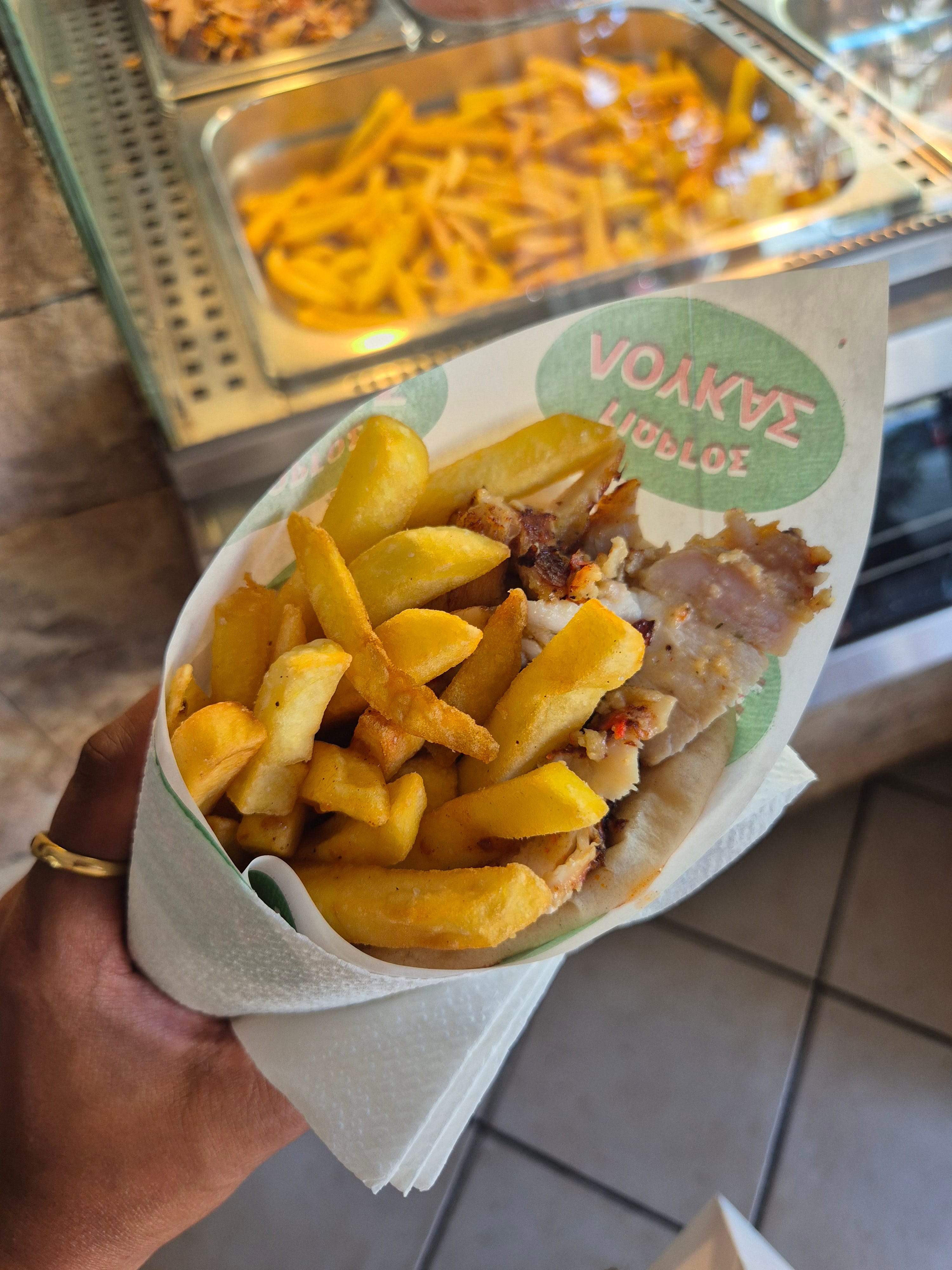
Recently I was on the Greek island of Corfu, hungry for lunch at a time that was teetering in the twilight zone between lunch and dinner, craving a dish that was both unctuous and fresh at the same time: the gyros.
I soon arrived at Grill Giorgos Loukas on the fringes of Corfu’s Old Town, a spot I had found through a manic, hunger-fuelled bout of obsessive research. I was met with scenes reminiscent of a charcoal chicken shop back home in Melbourne. Bronzed chickens were sweating over charcoal, imparting plumes of fatty smoke that I breathed in deeply with purpose. There was a small queue of locals who spoke to the owners by name and a shoddy little table for two people to sit at.
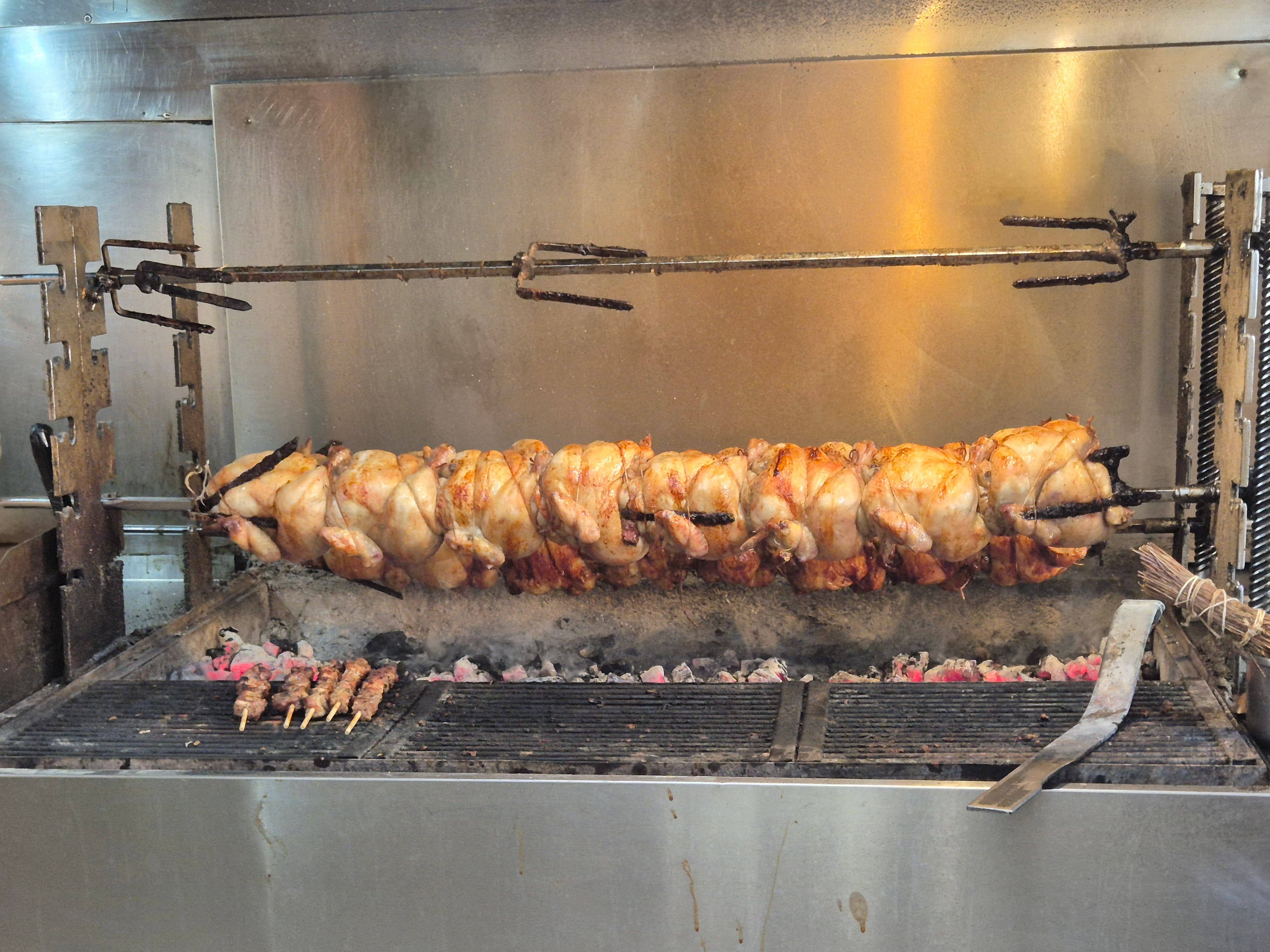
I ordered the gyros but there was no way I was leaving without some rotisserie chicken either. Both were undeniably exceptional. As the lady assembled my order I saw her ladle what I suspected was chicken jus over my gyros. But this was better, it was pastitsado sauce: the salty-sweet strained sauce derived from slow-cooked rooster in a tomato ragu, which is otherwise found cradling pasta in pastitsado.
A gyros is not a döner
As I both observed and gorged on my gyros, I started ruminating on its origins. Upon researching it, I came to learn that the word ‘gyro’ comes from the Greek ‘γυρίσω’ or ‘gyriso’, meaning ‘to turn’, and is a nod to the way the meat rotates on a vertical spit. Traditionally, thin slices of pork are marinated in olive oil, oregano, paprika, salt and pepper, with vinegar to tenderise the meat, before being stacked into a tight cone on the spit, sometimes topped with a thin slice of fat to moisten it during cooking. The cooked meat is shaved into pita and stuffed with tzatziki, tomato, onion and fries. It is distinct from souvlaki, otherwise known as the horizontal spit which I spied the chickens rotating on before, or small skewers of meat, taken from the word ‘souvla’.
But the gyros’ story reaches far beyond the Greek kitchen. Its predecessor, the döner kebab, emerged in 19th-century Anatolia or Asia Minor, what we now call Türkiye. The word comes from ‘dönmek’, ‘to turn’, and ‘kebap’, ‘roasted meat’. The döner kebab’s horizontal ancestor is known as Çağ kebabı.
It is widely contested as to who first invented the vertical spit, but it is safe to say it began in the early to mid-1800s in Anatolia and would go on to revolutionise Turkish cuisine and give birth to what we now know as döner kebab.
While some sources claim it was created in Bursa in the 1850s by a cook, butcher or a sir (it is all disputed) named İskender Efendi, others say it appeared earlier in the 1830s, thanks to a Kastamonu chef named Hamdi Usta, and Greek editors and journalists note the first recorded vertical döner in Smyrna in 1842.
Regardless of its mysterious creator, İskender Efendi can unequivocally be attributed to the Iskender kebab’s creation, where he placed a pide down, topped it with a pile of lamb that was grilled on a vertical spit over charcoal, then sliced thinly and topped with a hot tomato sauce, melted sheep butter and finally a dollop of yoghurt.
This method of vertical spit cooking inspired a culinary family, from shawarma in West Asia all the way through to tacos al pastor in Mexico brought over by Lebanese migrants.
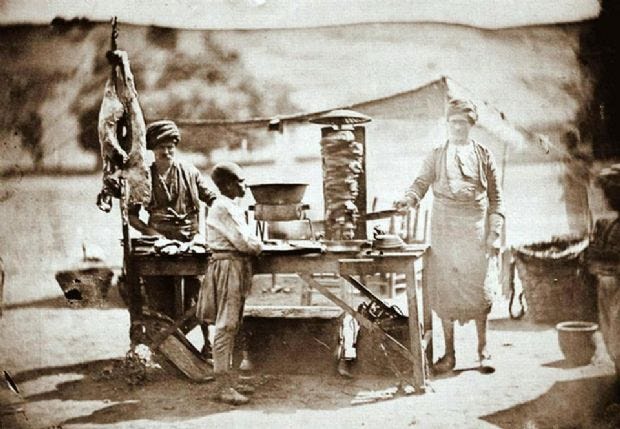
The history of Anatolia and its significance to the gyros
To understand how the gyros came to be, you need to first understand that it is a dish that embodies survival and was created by refugees.
So let us revisit Anatolia.
Anatolia has always been a crossroads of civilisations. Long before the Turks or Greeks arrived, Hattians, Hittites, Phrygians, Lydians and Greek colonists had settled its lands, building cities, trading and leaving layers of culture. The Turks migrated to Anatolia in the 11th century and eventually established the Ottoman Empire.
They ruled over a mosaic of Turks, Greeks, Armenians and other cultural and religious communities until the early 20th century when war and nationalism tore the region apart. From 1915 to 1916, Armenians were victims of genocide by the Ottoman government, otherwise known as the Young Turks at the time. The Young Turks were a group primarily composed of Balkan-born military officers and bureaucrats who had hoped non-Muslims, like the Orthodox Christian Armenians or Greeks, would buy into Turkish nationalism if it meant supposed progress and prosperity.
After the Ottoman Empire’s defeat in the First World War, Greece occupied western Anatolia, but Turkish nationalists under Mustafa Kemal Atatürk fought back in the Greco-Turkish War of 1919–1922, part of the Turkish War of Independence, which forced a Greek retreat. In 1922, the Great Fire of Smyrna, the city now known as Izmir in present-day Türkiye, devastated Greek and Armenian quarters, displacing and murdering hundreds of thousands of Anatolian Greeks and Armenians. The following year, Türkiye was formalised with the Treaty of Lausanne and a population exchange of over 1.6 million people was ordered, forcibly relocating Greek Orthodox Christians from Anatolia to Greece and Muslims from Greece to Turkey.
Refugees fleeing Constantinople and Smyrna in the 1920s went to Greece, namely cities like Athens and Thessaloniki, and set up popular street food stalls, where they adapted the döner to local tastes and their Orthodox Christian religions, swapping lamb for pork, pita for flatbread, tzatziki for tahini, and created what we now know as the gyros. A dish that carries both survival and adaptation and a story worth holding onto the next time you watch someone grow proud over a gyros.